• Spooky Reads 2025

    Spooky Reads 2025

    At the start of 2025, one of the goals I set for myself was that I wanted to refresh my website and begin writing here again. I got the site freshened up, and then it just sort of sat there. Until now. As we are approaching the Spooky Season, it means that I am on the verge of beginning of Spooky Reads 2025 and I decided that it would be an ideal time to start writing. This will be a good way for me to better reflect on what I am reading and share various thoughts I may have about the books I read for Spooky Reads.

    What is Spooky Reads 2025?

    First off, Spooky Reads is not anything official. Back in 2018 for the last two weeks or so of October (based on my Goodreads history), I decided to binge read horror novels and then decided to do the same thing the following years. As with many holidays, the start of Spooky Reads has crept earlier and earlier, until I am now beginning around the end of August or the beginning of September. It is not anything official, rather just something fun that I do, but anyone is welcome to join me in a their own little personal horror reading fest.

    (more…)
  • 5 Thoughts on Silk & Sinew

    Cover of "Silk & Sinew: A Collection of Folk Horror From the Asian Diaspora". The cover has a black background with brown text that transitions from golden to reddish-brown. A woman wearing a dress and mask that seem to be made of coiling roots and vines is the same brown colors.

    Spooky Reads 2025 has official commenced for me and the first book is laid to rest. I decided to begin this year’s binge of the macabre with Silk & Sinew: A Collection of Folk Horror from the Asian Diaspora edited by Kristy Park Kulski. Anthologies and folk horror being some of my favorite stuff to read, I figured this would be a good start to get the grinder motor running, and it certainly was.

    My girlfriend used to write and help manage a comic book site that has retired, and I would occasionally write some guest posts there. They had “5 Thoughts” format in place of reviews and recaps that I really liked and want to borrow/steal/use here. So here are five thoughts I have on this book:

    (more…)
  • Christmas Tree Skirts

    Christmas Tree Skirts

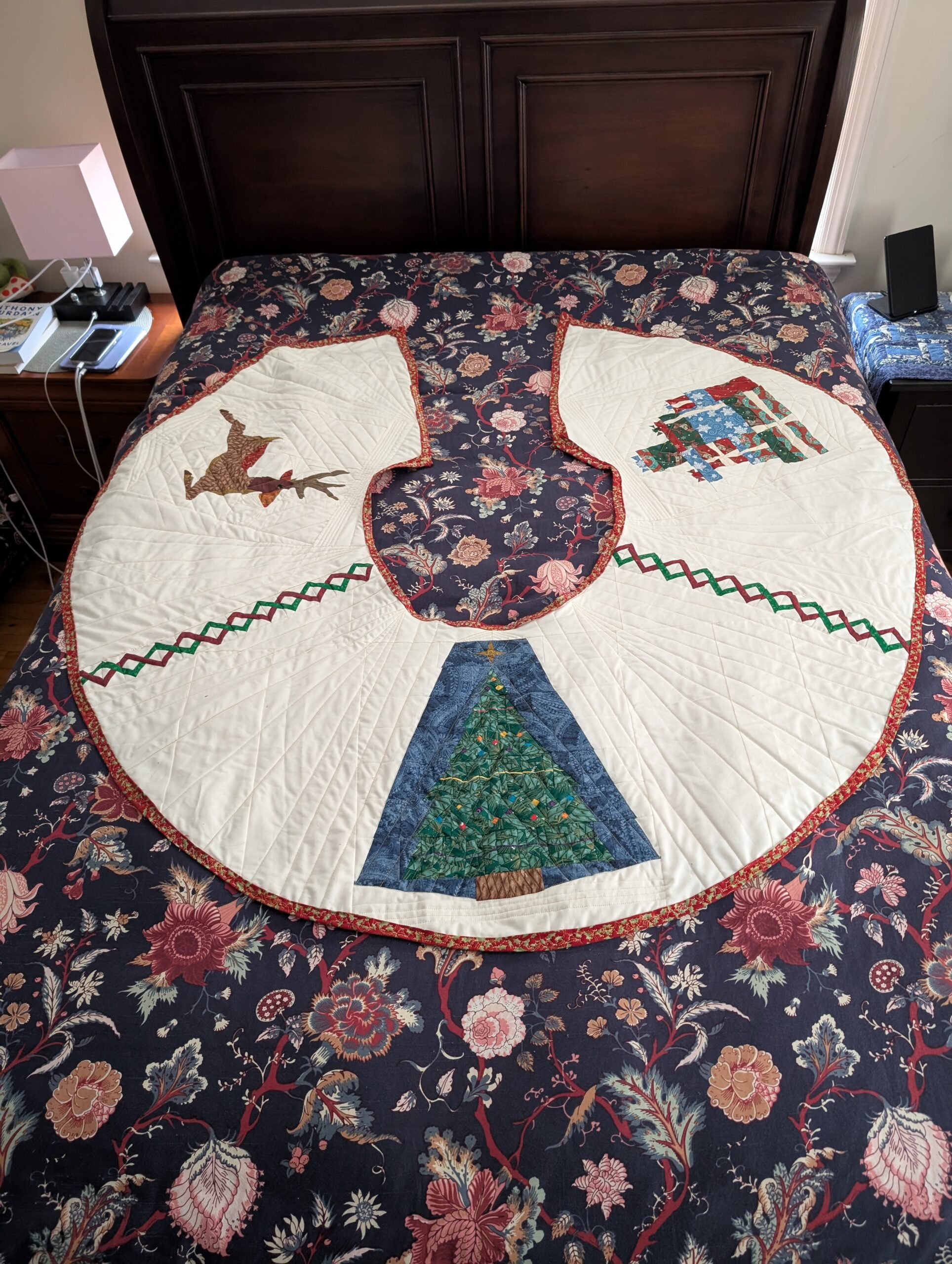
    Size: approximately 40-45″ diameter

    I think the most common image that the average person has when they hear “quilt” is the blanket style of quilts. Which is valid – a lot of quilts are blankets. But I am also fascinated in the other purposes quilts can be made for. I use the very first quilt I started (I should do a post about that one) as a cover on my nightstand. The polar bear quilt was always intended to be a wall hanging. Therefore, one of my earliest ideas was to make a Christmas tree skirt and it took working through several other projects before I was ready to tackle it. I am glad I did because I was more confident in my design and piecing skills, especially with foundation paper piecing. This was also the first full project I was going to do on my upgraded machine (I have a WIP scrap quilt that was the actual first project that I need to get back to).

    At the initial idea conception, I was just going to make a rectangular quilt that could be wrapped around the base of the tree. When I sat down to research what size I should make it, I noticed that most tree skirts are circular with a circular hole in the middle, so I decided to change to that shape. Then I needed to figure out how to make it. I also complicated matters when I decided that I wanted to make three tree skirts, the other two as gifts for my sister and mother – and that I would make all three simultaneously.

    I am sure there are actual patterns and instructions out there I could have used, but I decided to solve the problem myself. One of the things I enjoy about quilting is how solutions mainly involve breaking a project into smaller and smaller pieces until you get something easy to do, and then just build it up into the larger whole. I decided that I would create three wedges and then connect them with border strips. Each wedge would have a its own focal panel. I went through various ideas of Christmas imagery – I am an atheist so I wanted to avoid any particularly religious images – and settled on a Christmas tree, a reindeer, and a pile of gifts. For the border strips, I have wanted to piece some sort of helix shape for a while and decided this was a good time, I figured that would also be a useful FPP pattern to keep in the toolbox for future projects. The white background on the wedges were assembled as various rectangles and then I measured and cut the radii and the curves to get the shape I wanted.

    Then it was a process of designing the center blocks and doing the piecing. I managed to make all three Christmas tree blocks and most of the reindeer blocks before I felt that it was getting to close to Christmas for me to finish all 3. This worked out because I found I did not fully think about my backing fabric, and discovered that it was a standard 42″ wide and I had to Frankenstein pieces together to cover the whole area. I had enough for one, and I needed to order more for the other two in the future. I focused on finishing the one I would keep and managed to barely slip in under the wire and finished the binding at about 4:30 am on Christmas morning. I put it around the tree and went to bed.

    Following the holidays, I got back to finishing the other two and managed to wrap up both those projects in March 2025, after having to order a bunch more white fabric (I massively underestimated how much white I would need!) and more backing fabric which is why the second and third skirts match, but the first one is different. I still have the two skirts sitting on my quilt stand waiting to be given as gifts, since I felt it would be odd to give them in March, and they’ll be more useful if I give them around Thanksgiving.

    Overall, I was really pleased with how they came out. I need to work on my color choices in places, because I know the Christmas trees get lost in the blue background – I was trying to simulate an evening sky but the colors muddle too much. Trivia: the blue background fabric for the Christmas trees was from my leftover backing of the polar bear quilt. I have since learned about the trick of photographing the fabrics together in black & white and it will help determine if there is enough contrast. The Christmas trees were interesting to design because I tried to have some sort of randomness in the “branches” and in how the decorations were arranged. It is really tough to design randomness though because most of our minds are keyed to looking for patterns and we like to mentally settle into patterns. I am also really fond of the reindeer blocks. I am considering doing a couple of more and using them to make throw pillows to have out as Christmas decorations – just another project to add to the queue.

    (more…)
  • Polar Bear Quilt

    Polar Bear Quilt

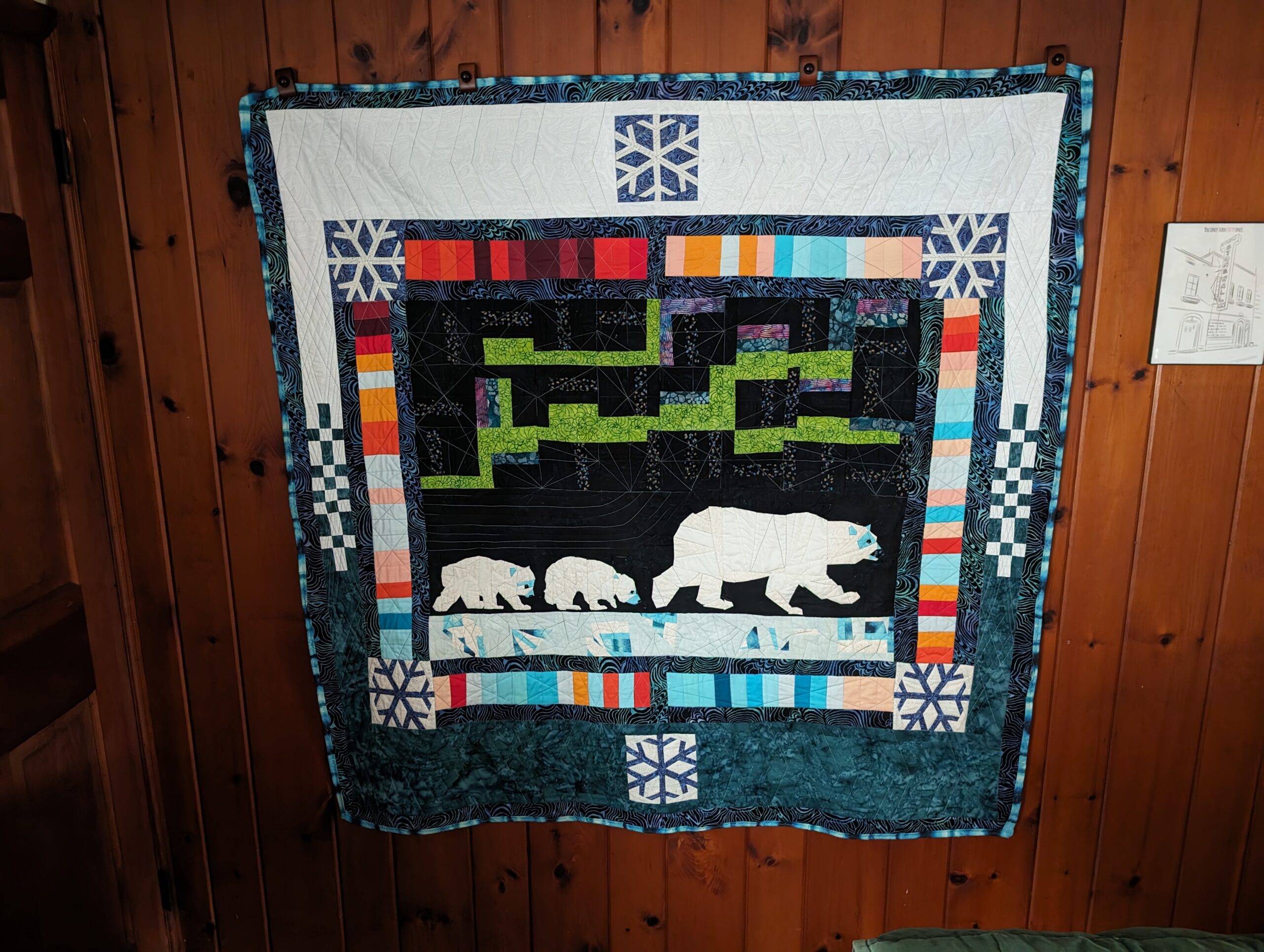
    Size: approximately 60″ x 60″
    Note: Foundation Paper Pieced polar bears and snowflakes. Striped border is warming stripes for Svalbard, Norway

    This is one of my quilts that I am probably most proud of. Polar bears are my favorite animals in the world (they’re just cute, but they’ll eat you if they could!). When I started quilting, I knew that I wanted to make something to honor these incredible animals. I am also endlessly fascinated with the ways that people have used various crafts as a means for data visualization – for example knitters who make temperature scarves – and I wanted to do something similar to acknowledge the ways that climate change is affecting polar bears drastically. So part of my design for the polar bear quilt is to use Warming Stripes to indicate changing temperatures. I decided to use the warming stripes for Svalbard, Norway as it is a well-recognized site for a polar bear community. Therefore, the blue to red striped border around the center panel reflects this visualization.

    Each quilt project is an opportunity to hone my skills and to potentially learn something new. For this quilt, I set myself on the path to learning foundation paper piecing (FPP). But I had to go beyond just learning how to paper piece, I had to figure out how to create the patterns myself and then how to create patterns for complicated organic shapes. My initial practice was in creating the pattern for the snowflake blocks that are at the top and bottom. I then used LibreCAD, with a great deal of trial and error and restarting, to import and trace reference images of an adult polar bear and cubs, and then how to cut that into my piecing pattern. It was complicated and I learned a ton doing this. I also learned that I really really enjoy this method of piecing, and it will likely be involved in nearly every project I do going forward.

    As for some other design choices for the polar bear quilt, I was originally going to just have a single block of fabric for the ice under their feet, but since ice is not homogeneous looking and using some FPP methods, I decided to piece together different colors of whites and blues. Later on when I quilted that section, I purposefully did it in a random scattered fashion as an attempt to symbolize the threat to sea ice levels that polar bears rely so much on. I also wanted to feature the Aurora Borealis, so I pieced together an abstract representation to hang in the sky above my polar bears. Finally, the top section of the quilt is white and the bottom is the green and teals to represent both the snowy sky and the Arctic Sea that is the polar bears’ habitat. I decided to Quilter’s Dream’s bamboo batting to be more environmentally friendly and this has become one of my favorite materials to work with.

    This was also the last project I made and completed on my Janome Magnolia 7330. I have since upgraded to a secondhand Janome MemoryCraft 8900 QCP that has been a great delight to work on.

    (more…)